28-03-2024
Hello and welcome to an extension from the previous odd groupings lesson. This time we are looking at some 7s instead of 5’s 1) This is just another simple accent pattern where we are accenting every 7th note. I have kept all of these examples in 7/4 this time so once again they resolve naturally. Take this slowly to start, really focusing on keeping the left foot strong and once you have it together, play along to a metronome. 2) Okay, lets see how well you’ve internalised the accent rhythm. We are just playing the accents along with a quarter note pulse in the left foot. Once you are happy with this, try increasing the speed and move it around the kit. At that point, it is great to alternate between 1 and 2 where you play the same accent pattern around the kit and keep all the unaccented notes from 1 on the snare. 3) This is the same principle as the last odd grouping lesson. This is another common accent pattern through 7s. We know have 3 accents in each hand before flipping the pattern to leading with the other hand. Follow the same steps from 1 and have some fun 4) As with 2, now we deal with just the accents over a 1/4 note pulse 5) This is the same accent pattern as 3 but the sticking has changed from alternating to RLRLRLL. Just like with the groupings of 5, this opens up a lot more movement around the kit as it leaves your right hand free to move anywhere. Just like with the grouping of 5 the independence required to keep the left foot going is a little trickier than in previous examples. 6) Okay so if you can play 4, this should be fairly straight forward. However, as it is all in the right hand, you will hopefully start to think of this as a right hand pattern over a groove. This can make a really cool ride bell pattern that goes over the bar line.
28-03-2024
Hello and welcome to a more general lesson on a rudiment that you really should know. The Paradiddle-diddle is a great rudiment that has so many useful applications. Lets just start off by making sure that you are happy with the basic principle. 1) This is the basic rudiment in the form most of us are familiar with. In this iteration, there is only one accent at the start of each part, in this case on the downbeat as we are playing 16th note triplets. Take your time making sure you can play this smoothly and there are only two dynamics. There should be a clear accent and a quiet unaccented note and no other volumes. Once you are happy with the pattern make sure you add the left foot in on quarter notes to help hear the subdivision. 2) I am always shocked by the amount of drummers that don’t bother to learn the opposite version of non alternating rudiments. What do I mean by that? Well the paradiddle-diddle stays as right hand lead pattern but obviously it can be played the other way round. Depending on how much you work on your weaker hand, this may be surprisingly difficult to play clean and keep the dynamics on point. Take your time and get it sounding good before moving on. 3) This is where I really start to love the sound and feel of the basic paradiddle-diddle. We are now playing it over 16th notes. I have written it out in 3/4 so that it resolves easily. Watch your left foot here and keep it playing 1/4 notes. 4) Fairly obvious here, it is just the left hand lead version played as 16ths with the left foot playing 1/4 notes. As before take your time to get it accurate and with good dynamics. 5) This exercise is fantastic hand warm up on so many levels. We get to work on both right hand and left hand lead and also on accents in both hands. Watch your dynamics here and make sure you keep the left foot on 1/4 notes.  
28-03-2024
Hello and welcome to another lesson blog.   In this one, I am going going over a couple basic ways to play groups of five notes.  This is more about building a foundation for some upcoming patterns and fills that are a bit more challenging. 1) This is just a simple accent pattern where we are accenting every 5th note.  I have kept all of these examples in 5/4 so the resolve naturally.  We will get into some more advanced applications soon.  Take this slowly to start, really focusing on keeping the left foot strong and once you have it together, play along to a metronome. 2) Okay, lets see how well you’ve internalised the accent rhythm.  Now we are just playing the accents along with a quarter note pulse in the left foot.  Once you are happy with this, try increasing the speed and move it around the kit.  At that point, it is great to alternate between 1 and 2 where you play the same accent pattern around the kit and keep all the unaccented notes from 1 on the snare. 3) Here is another super common accent pattern through 5s.  In this case it is two accents which alternate every two notes between each hand.  Follow the same steps from 1 and have some fun 4) As with 2, now we deal with just the accents over a 1/4 note pulse 5) This is the same accent pattern as 3 but the sticking has changed from alternating to RLRLL.  This is a great sticking that will open up a LOT of grove and fill options so spend some time really internalising it.  Be warned that some find the independence required to keep the left foot going a little trickier than in previous examples. 6) Okay so if you can play 4, this should be fairly straight forward.  However, as it is all in the right hand, you will hopefully start to think of this as a right hand pattern over a groove.  We will cover this exact application and more in the next lesson so do spend the time making this feel smooth and effortless. I hope you all enjoyed that and got something beneficial out of it.  Try and get these examples feeling solid so that we can really take these odd groupings to a more musical place in coming lessons with lots of cool groove and fill applications.  
28-03-2024
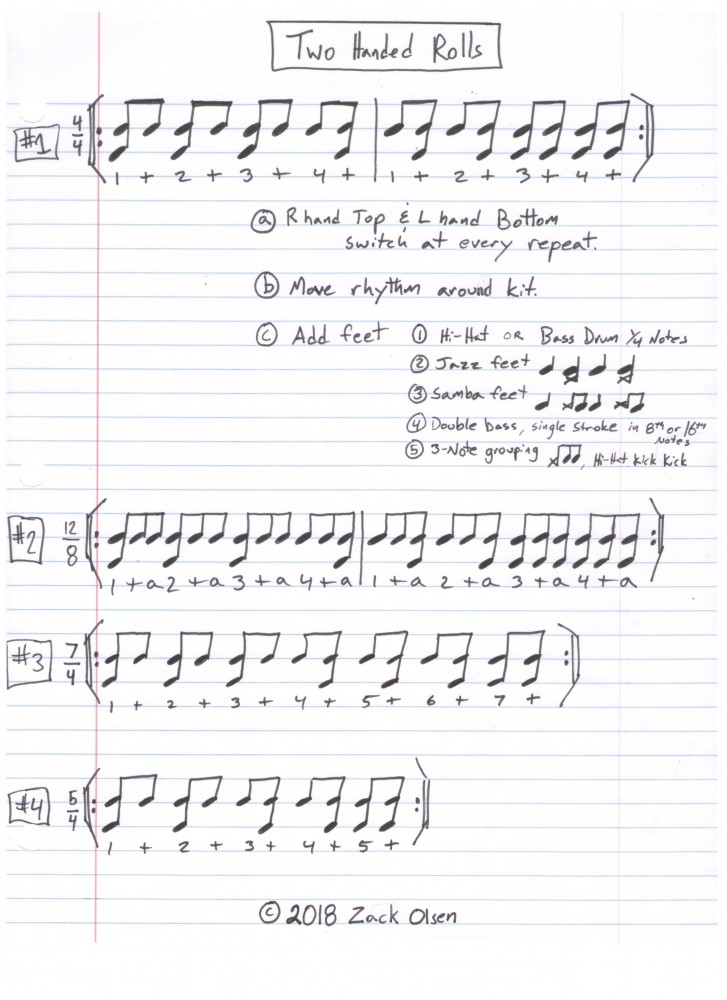
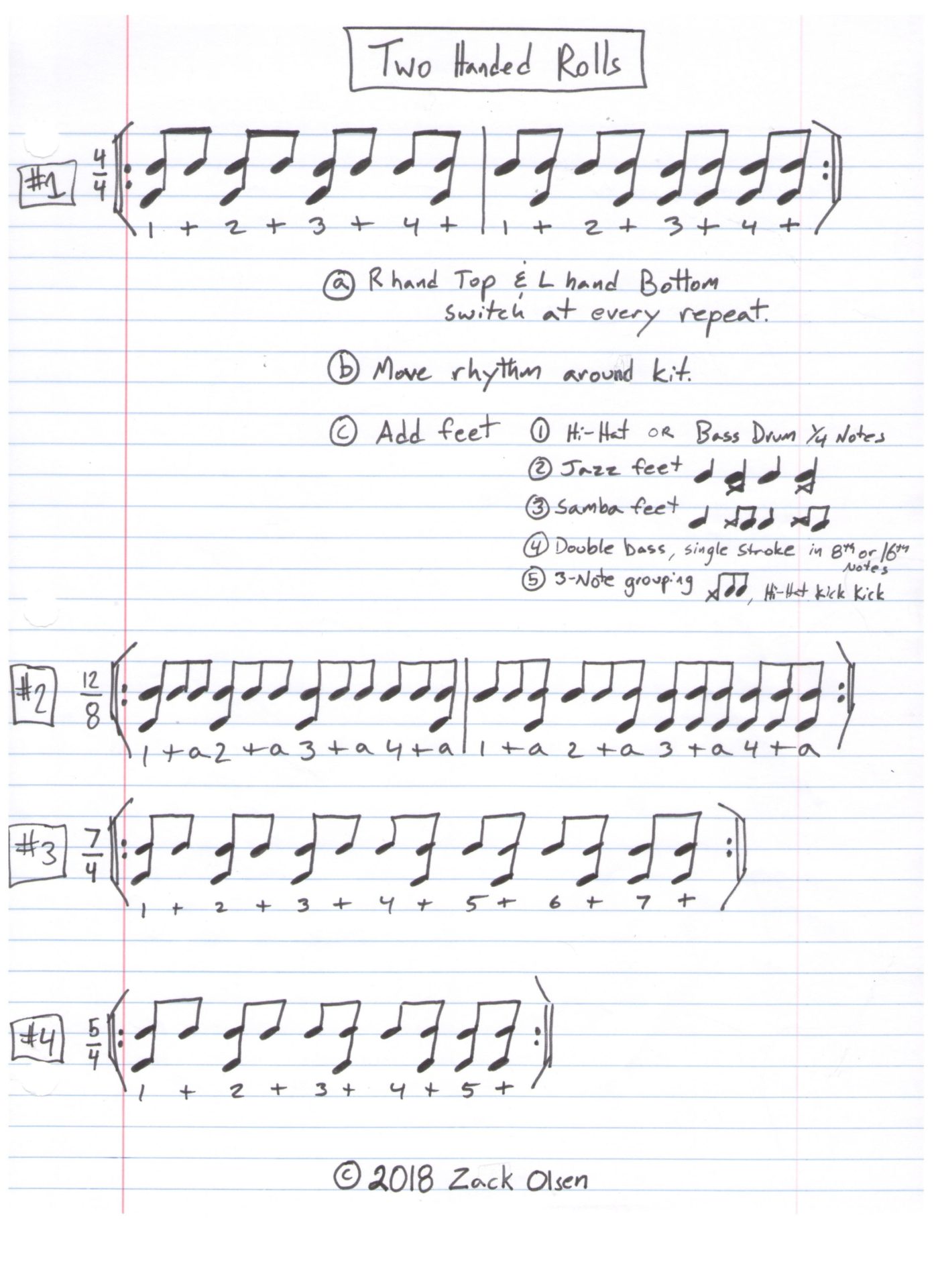
You never know where you’re going to find good inspiration. Backstage somewhere in Germany while on tour with my band Slow Gherkin, I was swapping warmup routines with the other drummers. Ido Blaustein, from the Israeli punk band Useless ID, showed me this first exercise. At least, I think he did; tour memories tend to be blurry. In any case, this was what I took from it. Thanks Ido! That was back in 2001. Since then, I’ve used it, taught it and morphed it. I’ve found it’s great for warming up, building coordination and internalizing rhythms. Joe Morello has some similar exercises in the “flat flam” section of his book Master Studies. There are so many opportunities to learn out there; just keep your ears and eyes open. I hope you find some joy in this exercise. —Zack I recommend starting on a practice pad. Make sure to get the sticks to hit exactly together when they are played in unison. One hand plays the top line while the other plays the bottom line. After mastering the rhythm in both hands, switch hands at every repeat—so if you start with your right hand playing the top line and your left playing the bottom, reverse them for the next measure. Let’s take the rhythm to the drum set. Pick two sound sources and play just like you did on the pad. I like to start off with floor tom and snare since they have contrasting sounds. After you are comfortable with this, try moving the rhythm around the drum set. Whatever hand is playing steady rhythm stays on one sound, for now. Now add the feet! 1. Quarter notes in hi-hat or bass 2. Jazz feet: hi hat 2&4 bass drum 1,2,3,4 3. Samba feet: hi hat 2&4 bass drum 1, “+” of 2, 3, “+“ of 4 4. Double-bass single stroke 8th or 16th notes 5. 3-note grouping in 8th notes: hi-hat kick kick Two Handed Rolls p1-page-001 After learning the ones I’ve made up, come up with your own. Take inspiration from the music you listen to. Explore rhythmic phrases you hear in other instruments. You don’t have to write it out. Sing it, play it!  
Newsletter

Register to be informed about fairs, organizations, announcements and current information.

Within the scope of commercial electronic message permission, I allow e-mails to be sent to me regarding promotions and campaigns.

Contact Us

For support, questions or feedback, mail us at

  • SANAYI MAHALLESI (EVREN OTO SANAYI SITESI) 1691 SOKAK NO.5-7-9, HOŞDERE YOLU 34510 ESENYURT- ISTANBUL / TURKEY
  • 90 212 672 16 01 - 672 65 22
  • info@istanbulmehmet.com