
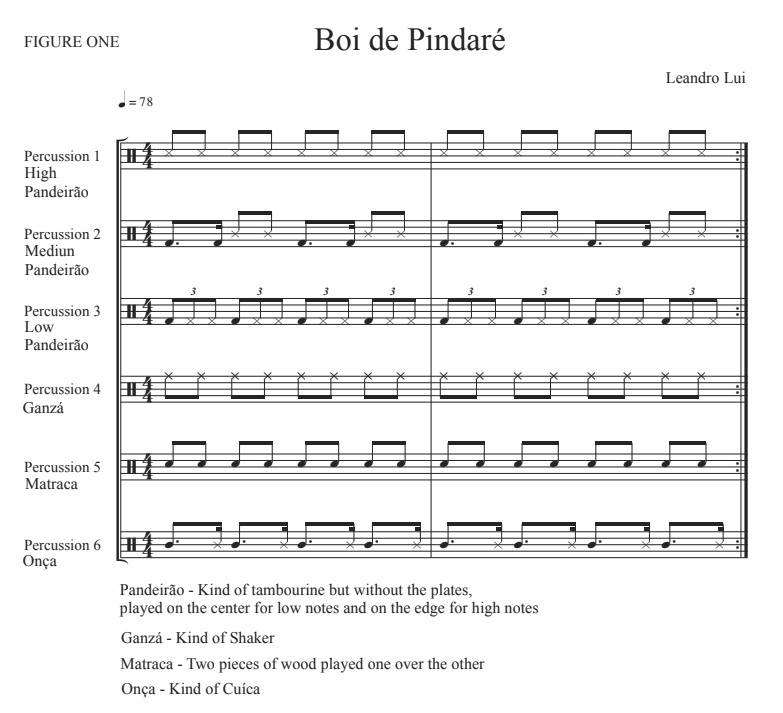
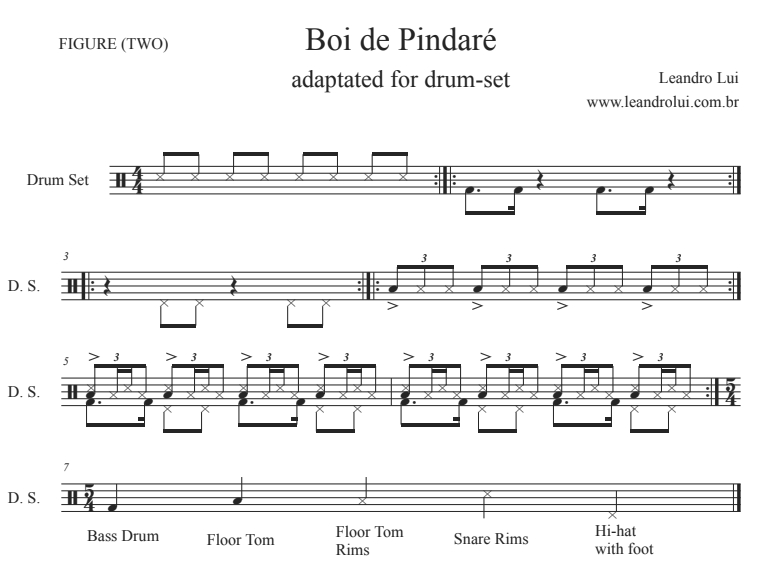
 It is good to keep in mind that the adaptations are transpositions from bass and treble instruments to bass and treble drums, so the rhythm looks like this:
Sheet Music:
You can check the groove of the “Boi de Pindaré” in the video below:
https://www.youtube.com/watch?v=FSEdkHJhlM8 Since there are no rules on how to adapt Brazilian rhythms to drums, you can listen to the “Boi de Pindaré” and, while you do so, you may want to explore your own creativity and develop the rhythms presented here your way. See you soon, Lui.www.leandrolui.com.br
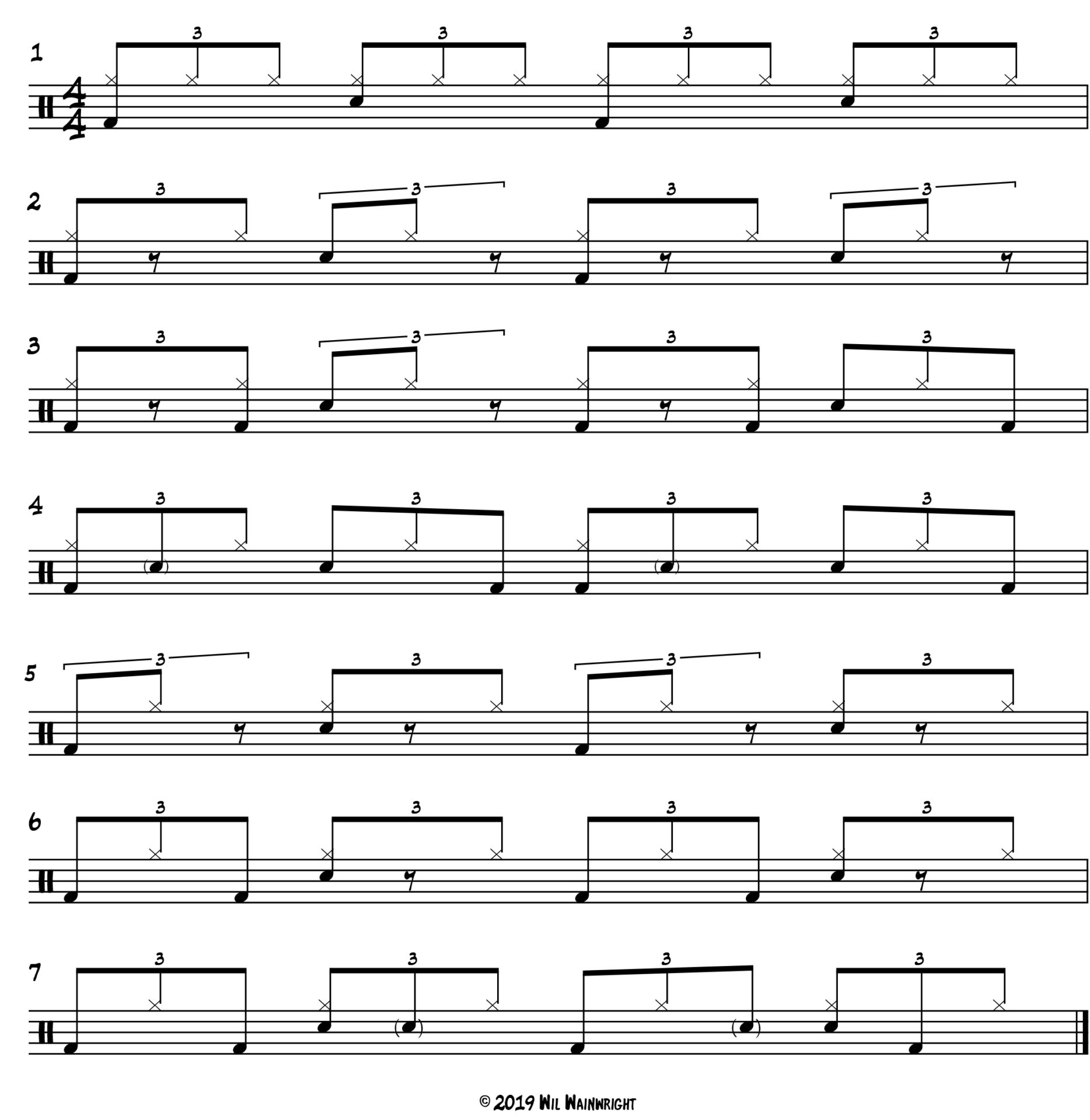 Hello and welcome to a lesson where we will be having a look at a different way of approaching a 12/8 feel. We will be applying a 2 over 3 feel in the right hand giving a fresh feel and sound to this classic feel.
1) So to start off we are just playing the basic 12/8 style. I have written it in triplets as it will make the following exercises a little clearer. Even if you feel confident with this style, do your due diligence and warm up this groove and make sure it is feeling relaxed and sounding good before moving on to the next exercises.
2) In the next example we start applying the first of our two polyrhythmic approaches. In essence it is a very simple idea. We are just playing every other triplet partial. We are just playing a basic groove underneath this. Take your time and make sure you get this feeling good. I would recommend alternating between this and example 1 along with a metronome.
3) In the third example, lets start adding in some extra bass drums.
4) Next up we are adding in some bass drums and ghosted snare notes. We are really filling in the gaps between the hats a lot more now which has two effects. Firstly, I think it gives it a slicker feel that rolls round nicely. This is due to filling in the subdivisions more so your brain feels the triplet pulse easier. Secondly, as we have a lot of notes that don't fall with the hihat, it is easy to feel the backbeat as an off beat rather than where it actually falls on beats 2 and 4. If you struggle to hear the groove as it should be, try alternating between this and example 1.
5) In example 5 we go back to the basic grove and displace the right hand by one 8th note triplet partial. This means that beats 1 and 3 are now on their own and the snares on 2 and 4, now have the hihat falling in unison with the snare. Once you have this feeling good, go aback and alternate between this and example 1.
6) In example 6 we are going to add some bass drums in and make this feel a bit more like a groove.
7) Finally we are going to fill up the groove a bit with some bass drums and ghosted snare notes. As with example 4, the more notes we add, the easier it is to feel the triplet subdivision rolling underneath.
https://youtu.be/Ozo17GgOL0E
I hope you enjoyed that lesson, see you next time.
Hello and welcome to a lesson where we will be having a look at a different way of approaching a 12/8 feel. We will be applying a 2 over 3 feel in the right hand giving a fresh feel and sound to this classic feel.
1) So to start off we are just playing the basic 12/8 style. I have written it in triplets as it will make the following exercises a little clearer. Even if you feel confident with this style, do your due diligence and warm up this groove and make sure it is feeling relaxed and sounding good before moving on to the next exercises.
2) In the next example we start applying the first of our two polyrhythmic approaches. In essence it is a very simple idea. We are just playing every other triplet partial. We are just playing a basic groove underneath this. Take your time and make sure you get this feeling good. I would recommend alternating between this and example 1 along with a metronome.
3) In the third example, lets start adding in some extra bass drums.
4) Next up we are adding in some bass drums and ghosted snare notes. We are really filling in the gaps between the hats a lot more now which has two effects. Firstly, I think it gives it a slicker feel that rolls round nicely. This is due to filling in the subdivisions more so your brain feels the triplet pulse easier. Secondly, as we have a lot of notes that don't fall with the hihat, it is easy to feel the backbeat as an off beat rather than where it actually falls on beats 2 and 4. If you struggle to hear the groove as it should be, try alternating between this and example 1.
5) In example 5 we go back to the basic grove and displace the right hand by one 8th note triplet partial. This means that beats 1 and 3 are now on their own and the snares on 2 and 4, now have the hihat falling in unison with the snare. Once you have this feeling good, go aback and alternate between this and example 1.
6) In example 6 we are going to add some bass drums in and make this feel a bit more like a groove.
7) Finally we are going to fill up the groove a bit with some bass drums and ghosted snare notes. As with example 4, the more notes we add, the easier it is to feel the triplet subdivision rolling underneath.
https://youtu.be/Ozo17GgOL0E
I hope you enjoyed that lesson, see you next time.
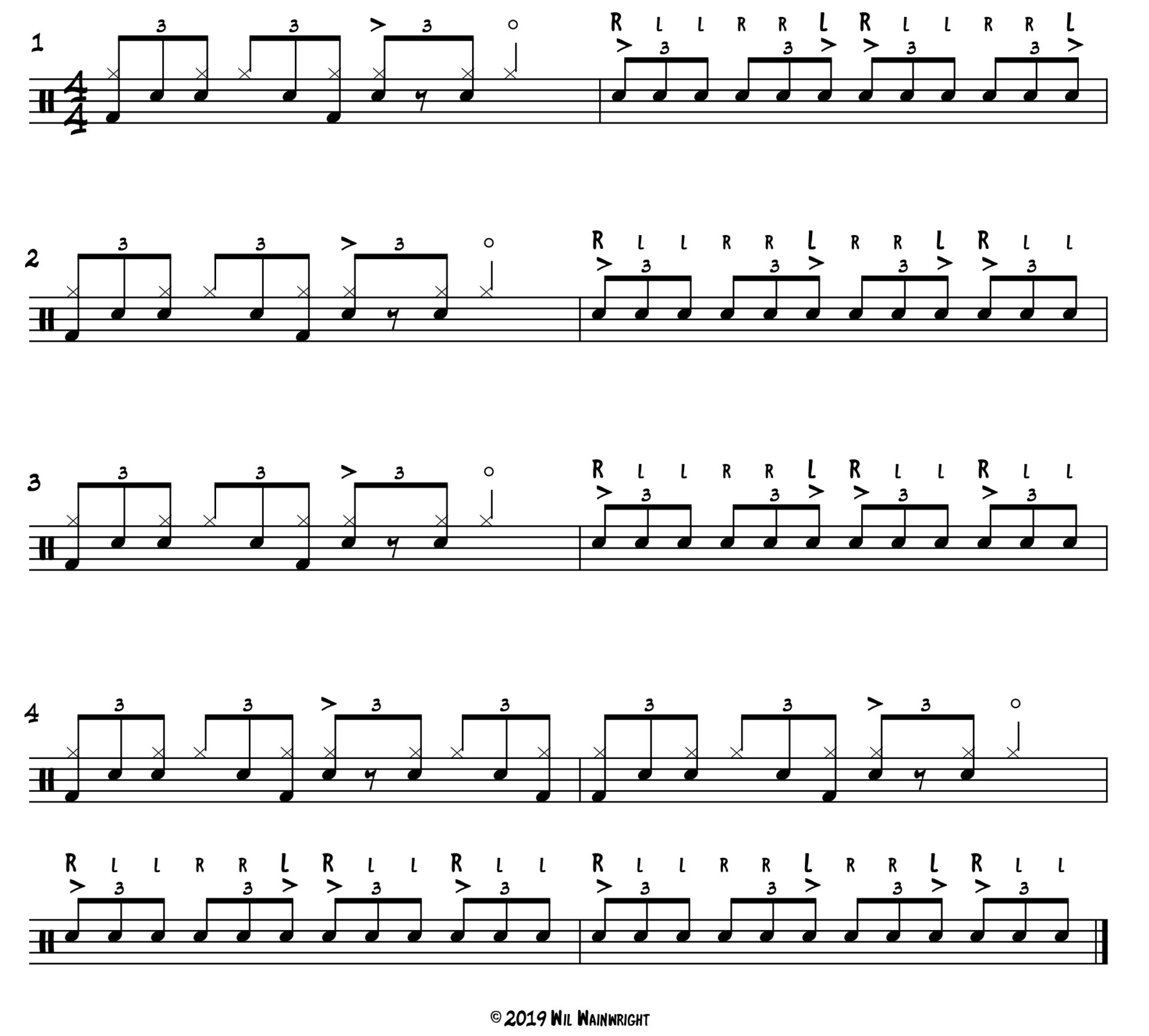 1) In this first exercise we are playing a bar of the half time shuffle and a bars worth of the 6-stoke roll as 8th note triplets. Note that we are playing an open hihat on beat 4 of the first bar. This is just there to help us transition a little easier into the 6-stroke roll. As always take your time and increase the tempo slowly.
2) Next up we have almost the same as in 1 but the fill is now one 6-stroke roll and one “inverted” 6-stroke. Really focus on your dynamics during the fill and make sure you are only accenting the accented notes.
3) In the third example, during the fill, we are now playing a 6-stroke roll followed by two groups of RLL.
4) In the final example we have combined the fills from 2 and 3 and created a four bar phrase. Really try and focus on your dynamics and make your ghost notes in the groove a similar volume to the unaccented notes of the fills.
https://youtu.be/AWsmQL0VG9E
I hope you enjoyed that lesson, see you next time.
1) In this first exercise we are playing a bar of the half time shuffle and a bars worth of the 6-stoke roll as 8th note triplets. Note that we are playing an open hihat on beat 4 of the first bar. This is just there to help us transition a little easier into the 6-stroke roll. As always take your time and increase the tempo slowly.
2) Next up we have almost the same as in 1 but the fill is now one 6-stroke roll and one “inverted” 6-stroke. Really focus on your dynamics during the fill and make sure you are only accenting the accented notes.
3) In the third example, during the fill, we are now playing a 6-stroke roll followed by two groups of RLL.
4) In the final example we have combined the fills from 2 and 3 and created a four bar phrase. Really try and focus on your dynamics and make your ghost notes in the groove a similar volume to the unaccented notes of the fills.
https://youtu.be/AWsmQL0VG9E
I hope you enjoyed that lesson, see you next time.

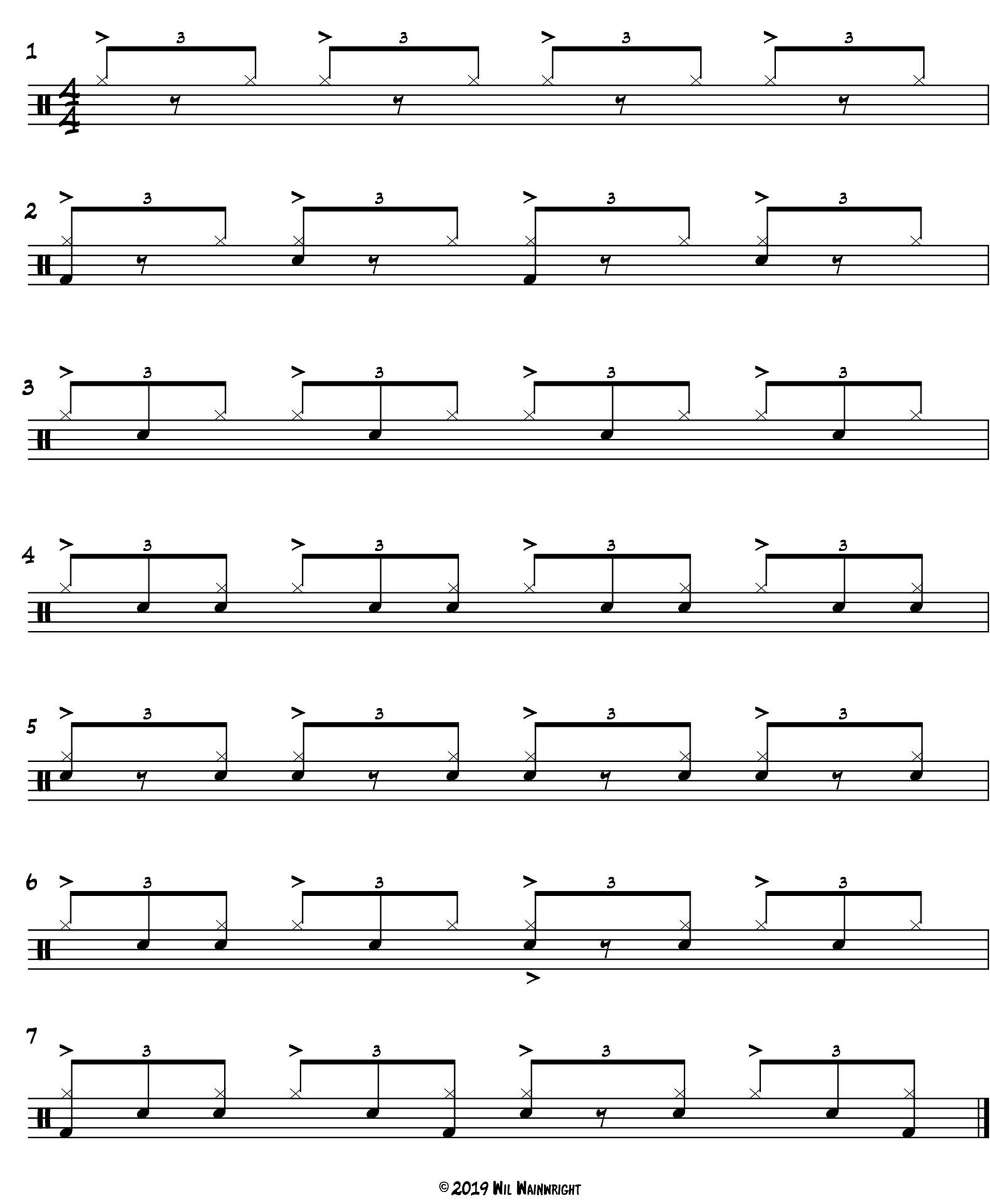 1) In this first exercise we are simply playing a shuffle in the hihat. Make sure your dynamics are accurate and consistent.
2) Next up we add in bass and snares to create a standard shuffle. This is more about focusing on the right hand and making sure your dynamics are on point. There are no ghost notes just yet so focus on playing a clear and strong snare on beats 2 and 4.
3) The first ghost note we are going to add is the middle triplet. Concentrate on getting the volume nice and low whilst keeping the accent pattern in the right hand correct and consistent.
4) Now we add in the third triplet partial as well as the second with our left hand. This can be challenging, especially trying to maintain the correct dynamics. Take your time until this feels smooth.
5) In this exercise both of our hands are playing a shuffle in unison. However, I want you to keep the left hand dynamic low throughout. It is much easier to add volume then take it away. Work on the independence until you can play this smoothly.
6) In our penultimate exercise we have the full hands pattern for this particular groove. Please not that the snare on the downbeat of 3 is an accented snare.
7) The full groove. We have just added three bass drums to this groove and it sounds great.
https://www.youtube.com/watch?v=kTIAT3G3Qro&feature=youtu.be
I hope you enjoyed that lesson, see you next time.
1) In this first exercise we are simply playing a shuffle in the hihat. Make sure your dynamics are accurate and consistent.
2) Next up we add in bass and snares to create a standard shuffle. This is more about focusing on the right hand and making sure your dynamics are on point. There are no ghost notes just yet so focus on playing a clear and strong snare on beats 2 and 4.
3) The first ghost note we are going to add is the middle triplet. Concentrate on getting the volume nice and low whilst keeping the accent pattern in the right hand correct and consistent.
4) Now we add in the third triplet partial as well as the second with our left hand. This can be challenging, especially trying to maintain the correct dynamics. Take your time until this feels smooth.
5) In this exercise both of our hands are playing a shuffle in unison. However, I want you to keep the left hand dynamic low throughout. It is much easier to add volume then take it away. Work on the independence until you can play this smoothly.
6) In our penultimate exercise we have the full hands pattern for this particular groove. Please not that the snare on the downbeat of 3 is an accented snare.
7) The full groove. We have just added three bass drums to this groove and it sounds great.
https://www.youtube.com/watch?v=kTIAT3G3Qro&feature=youtu.be
I hope you enjoyed that lesson, see you next time.
Newsletter
Register to be informed about fairs, organizations, announcements and current information.
Within the scope of commercial electronic message permission, I allow e-mails to be sent to me regarding promotions and campaigns.For support, questions or feedback, mail us at

